
We all have heard about people having a twin. But what if I told you that my car has a digital twin ! Let us understand Embodied AI in Autonomous driving and car’s digital twin.
Embodied AI is at the forefront of transforming the landscape of autonomous and self-driving cars, paving the way for safer roads and enhanced transportation systems. But what exactly is Embodied AI, and how does it revolutionize the realm of autonomous driving?
Embodied AI refers to the integration of artificial intelligence within physical systems, enabling them to perceive, interpret, and interact with the surrounding environment in real-time. In the context of autonomous vehicles, it entails equipping cars with sophisticated sensors, actuators, and intelligent algorithms to navigate roads autonomously while ensuring safety and efficiency.
Now, let’s delve into the fascinating realm of digitization or digital twin technology and its pivotal role in advancing autonomous driving:
🔍 Digitization and Digital Twin of Cars:
Digitization involves creating a virtual representation of physical objects or systems. In the case of cars, this entails developing a digital twin—a highly detailed, dynamic model that mirrors the behavior, characteristics, and functionality of its real-world counterpart. By continuously syncing data between the physical vehicle and its digital twin, automakers and AI engineers can:
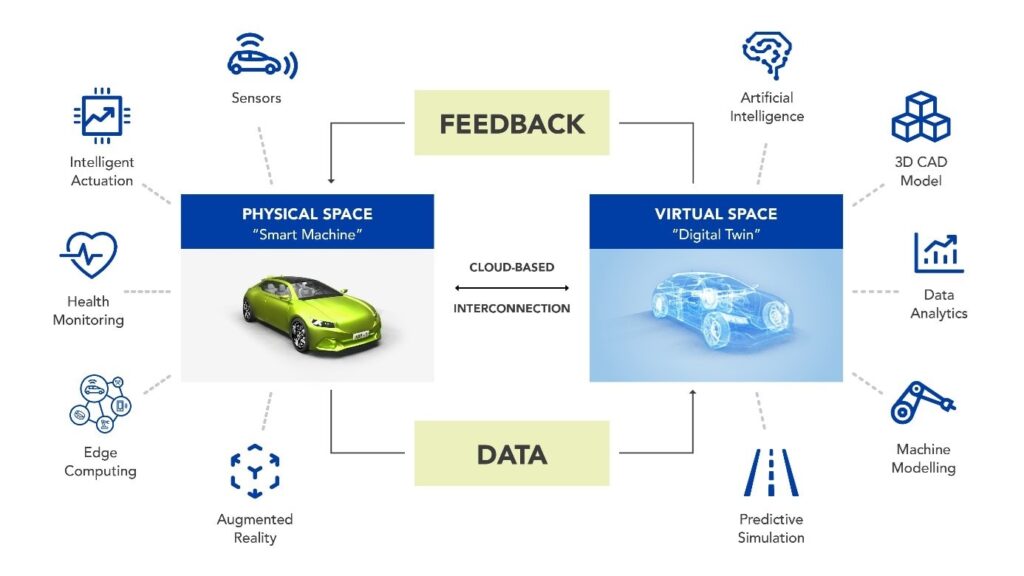
Image Credit : NXP
- Enhance Training and Testing: Digital twins serve as invaluable tools for training AI algorithms and conducting extensive simulations in a safe, controlled environment. This enables developers to expose autonomous systems to a myriad of complex scenarios, including rare edge cases and adverse weather conditions, which are crucial for refining their decision-making capabilities.
- Iterative Development: Through iterative refinement and optimization, digital twins facilitate the rapid prototyping and iteration of autonomous driving systems. Engineers can simulate various design modifications and algorithmic enhancements, accelerating the development cycle and reducing time-to-market.
- Predictive Maintenance: By leveraging real-time sensor data and predictive analytics, digital twins enable proactive maintenance and diagnostics, thereby minimizing downtime and optimizing the operational efficiency of autonomous fleets.
🛣️ Predicting and Comparing On-Road Performance through Off-Road Simulation:
One of the greatest challenges in autonomous driving lies in accurately predicting and comparing on-road performance across different driving conditions. Here’s how off-road simulation powered by digital twins addresses this challenge:
- Scenario Generation: Off-road simulation platforms leverage digital twins to generate diverse and realistic driving scenarios, encompassing a wide spectrum of environmental factors, traffic conditions, and pedestrian behaviors. By meticulously crafting these scenarios, developers can assess the robustness and adaptability of autonomous systems under various challenging conditions.
- Performance Benchmarking: Through off-road simulation, developers can systematically benchmark the performance of different autonomous driving algorithms and sensor configurations. By quantitatively evaluating metrics such as safety, efficiency, and comfort across diverse scenarios, stakeholders can make informed decisions regarding technology integration and deployment strategies.
- Continuous Learning and Improvement: Off-road simulation serves as a continuous learning loop, wherein insights gleaned from simulated scenarios inform the iterative refinement of AI algorithms and sensor fusion techniques. By iteratively exposing autonomous systems to increasingly complex and diverse challenges, developers can enhance their resilience and reliability over time.
In conclusion, Embodied AI, coupled with digitization and off-road simulation, heralds a new era of innovation in autonomous driving, promising safer roads, enhanced mobility, and unprecedented levels of efficiency. As we continue to push the boundaries of technological advancement, let us harness the power of AI to shape a future where transportation is not just autonomous but truly intelligent. 🌐🚀 #AutonomousDriving #EmbodiedAI #DigitalTwin #Innovation #FutureofMobility
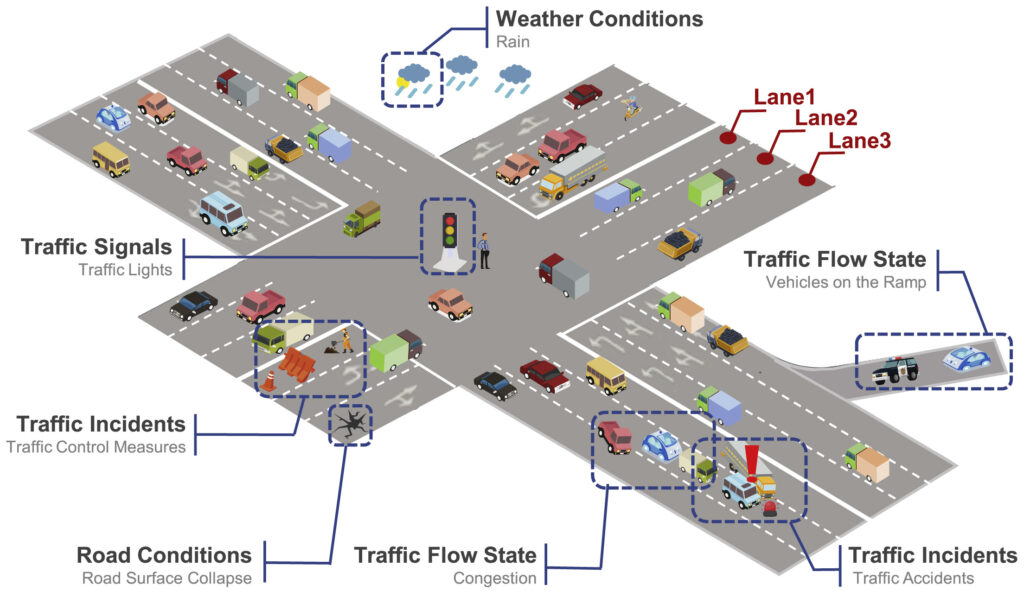
Image Credit : Zhou, Zewei et al. “A comprehensive study of speed prediction in transportation system: From vehicle to traffic.” iScience 25 (2022): n. pag.
License info about article containing above image : https://creativecommons.org/licenses/by/4.0/