
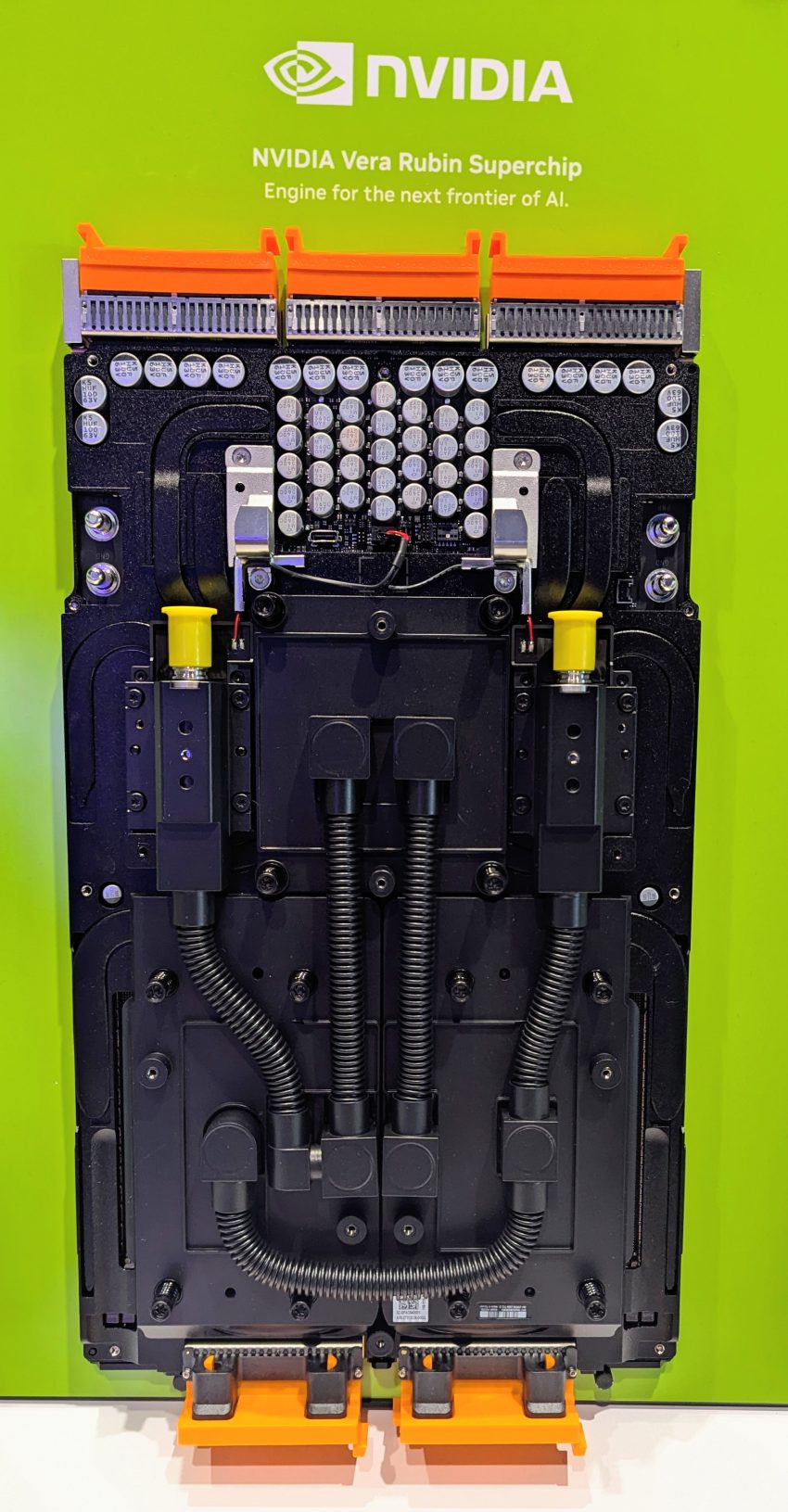
I attended NVIDIA GTC 2026 last week, where I explored the future of AI infrastructure firsthand. The NVIDIA Vera Rubin Superchip stood out as the most important innovation, redefining how AI data centers are built and scaled. In this blog, I break down its architecture, specs, and real-world deployment based on what I observed.
The NVIDIA Vera Rubin Superchip is not just another GPU. It is the foundation of modern AI data centers.
🧭 My GTC 2026 Walkthrough Experience
At GTC 2026, two things dominated the show floor:
🤖 Robotics Systems
- Dual-arm robots performing real tasks
- AI models controlling motion in real time
- Vision-language-action systems in production
🏭 AI Data Center Infrastructure
- Full GPU racks with liquid cooling
- Cooling Distribution Units (CDUs)
- High-density power systems
👉 This led to a key realization:
AI is no longer software. It is infrastructure powered by the Vera Rubin Superchip.
🧠 Why the NVIDIA Vera Rubin Superchip Exists
The NVIDIA Vera Rubin exists because AI workloads have changed.
Old Approach
- Training-focused systems
- Batch processing
- GPU scaling
New AI Requirements
- Continuous inference
- AI agents running 24/7
- Real-time reasoning
New Bottlenecks
- Memory bandwidth
- Data movement
- Interconnect latency
👉 Therefore:
The NVIDIA Vera Rubin Superchip solves system-level bottlenecks, not just compute.
🧩 What Is the NVIDIA Vera Rubin Superchip?
The NVIDIA Vera Rubin Superchip is a tightly integrated compute system.
It includes:
- A high-performance CPU
- Two GPUs
- High-bandwidth memory
- NVLink interconnect
👉 It behaves like a single processor, but it is a multi-die system.
⚙️ NVIDIA Vera Rubin Superchip Specifications
Core Architecture
- 88-core ARM CPU
- 2× Rubin GPUs
- ~6 trillion transistors
Compute Performance
- ~100 PFLOPS per superchip
Rack scale:
- NVL144 → ~3.6 exaflops
- NVL576 → ~15 exaflops
Memory System
- HBM4 memory
- ~288 GB per GPU
- ~2 TB total memory
- ~13 TB/s bandwidth
Interconnect
- NVLink-C2C → 1.8 TB/s
- NVLink 6 → rack-scale fabric
🔥Vera Rubin Superchip vs Blackwell
The Vera Rubin improves on Blackwell in key ways.
| Feature | Blackwell | Vera Rubin |
|---|---|---|
| CPU | Grace | Vera |
| Focus | Training | Inference |
| Memory | HBM3e | HBM4 |
| Interconnect | NVLink 5 | NVLink 6 |
👉 Key takeaway:
The NVIDIA Vera Rubin Superchip enables AI factories, not just faster GPUs.
🧬 Design of the Vera Rubin Superchip
The Vera Rubin Superchip has a unique design.
Key Features
- Reticle-sized GPUs
- Dual-sided connectors
- Dense power delivery
- Liquid cooling optimized
👉 This design supports extreme performance and scalability.
🏭 Manufacturing of the Nvidia Vera Rubin Superchip
The Vera Rubin is built using advanced manufacturing.
Process
- 3nm-class node
- Chiplet-based architecture
- HBM4 integration
Complexity
- Memory stacking
- Thermal engineering
- Packaging challenges
👉 This is system-level manufacturing.

🌊 Cooling in NVIDIA Vera Rubin Systems
Cooling is critical for the Vera Rubin Superchip.
Required Components
- Liquid cooling systems
- CDUs
- Rack-level cooling
👉 Air cooling is not sufficient.
🖥️ How Nvidia Vera Rubin Superchip Fits in Servers
Smallest Unit
- Single superchip
Node
- Multiple superchips
Rack
- NVL72 / NVL144 / NVL576
👉 The rack behaves like a single massive GPU.
📦 Smallest Deployment
The smallest deployment of this AI Superchip is:
- One superchip (theoretical)
- Multi-chip node (practical)
👉 Most real deployments are rack-scale.
🤖 Workloads Enabled
The Vera Rubin powers:
- LLM inference
- Robotics
- AI agents
- Real-time decision systems
🧭 AI Factory Concept
The NVIDIA Vera Rubin enables AI factories.
| Old | New |
|---|---|
| Servers | AI factories |
| Batch jobs | Continuous inference |
| GPUs | Rack-scale systems |
🧠 Final Insight
The Vera Rubin Superchip proves:
The bottleneck is no longer compute. It is data movement and system design.
🔮 Conclusion
The Vera Rubin is the foundation of modern AI infrastructure.
It powers:
- AI factories
- Robotics systems
- Large-scale inference
👉 This is the future of computing.