
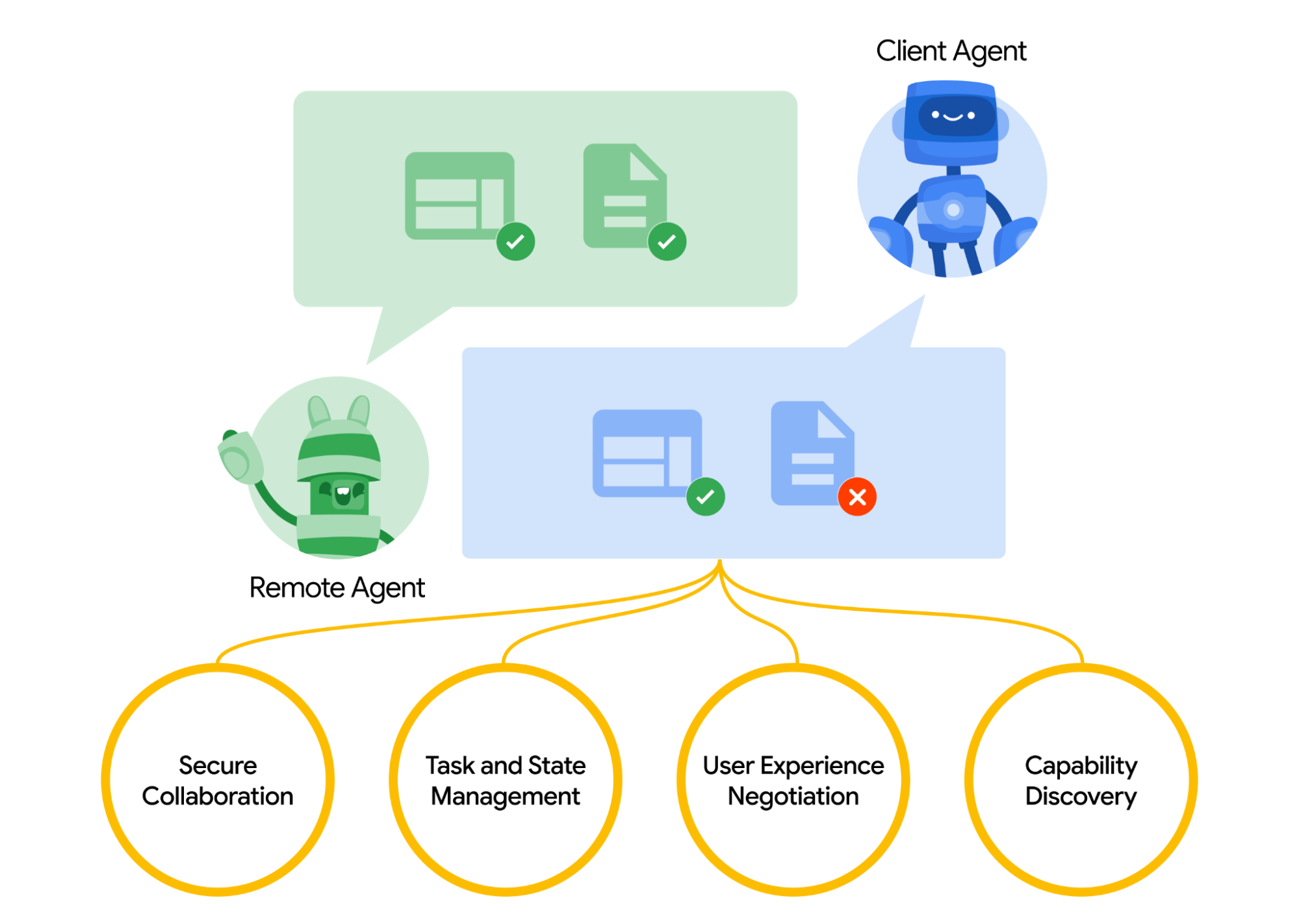
Google has introduced the Agent2Agent (A2A) protocol, a revolutionary open standard designed to enable seamless communication between AI agents. This innovation, backed by over 50 major tech partners, allows autonomous agents to collaborate across platforms, applications, and organizations—even when built using different technologies.
🌐 Why the Agent2Agent Protocol Is a Game-Changer
As AI agents become central to productivity and automation, enterprises face a major challenge: AI agents often can’t talk to each other. Without a standard protocol, they’re siloed, and their potential is limited.
Google’s A2A protocol solves this by providing a secure, scalable, and open way for agents to:
- Exchange structured tasks and results
- Work asynchronously across platforms
- Handle multiple data formats including text, audio, video, and files
🧠 Core Concepts of the Agent2Agent Protocol
👤 Key Roles in Agent2Agent protocol
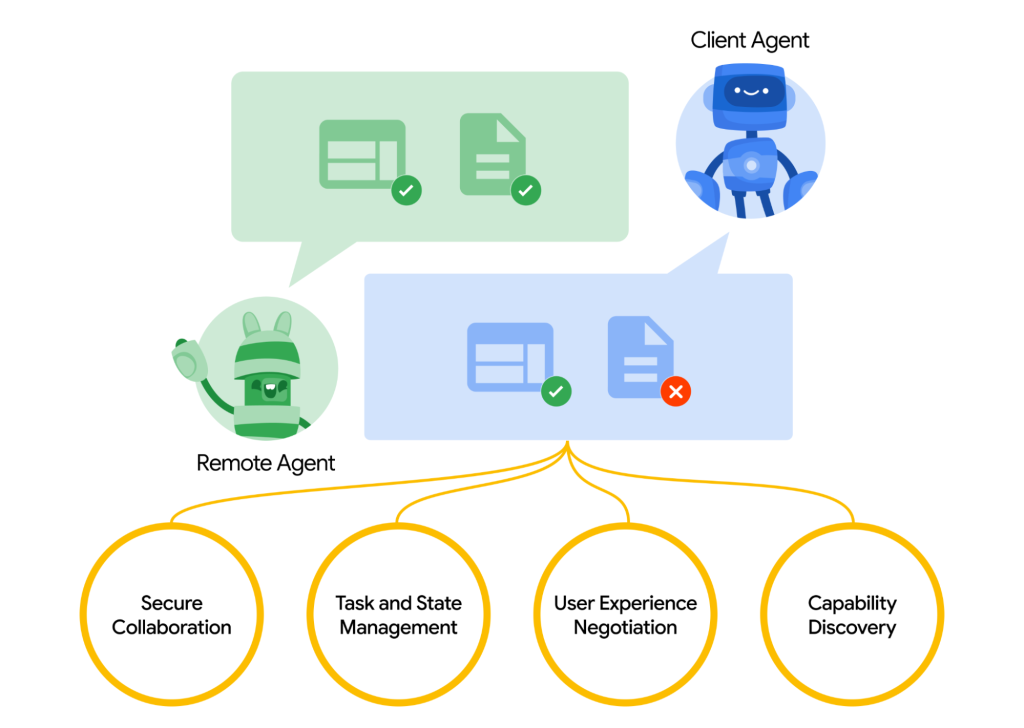
A2A defines three main participants:
- User – A human or service initiating a request
- Client Agent – Acts on behalf of the user
- Remote Agent – Fulfills the task via A2A
This structure supports both human-in-the-loop and fully automated workflows.
🔌 Transport and Communication in the Agent2Agent Protocol
- Transport: HTTP(S) + Server-Sent Events (SSE)
- Protocol Format: JSON-RPC 2.0
- Discovery: Agent Cards using standard JSON hosted at
.well-known/agent.json
🪪 Agent Cards: Advertise Capabilities
Agent Cards describe what an agent can do, its supported modalities, and authentication requirements. Here’s an example:
{
  "name": "Google Maps Agent",
  "description": "Plan routes and generate directions",
  "url": "https://maps-agent.google.com",
  "skills": [
    {
      "id": "route-planner",
      "name": "Route planning",
      "description": "Helps plan routing between two locations",
      "tags": ["maps", "routing"]
    }
  ]
}
These Agent Cards help other agents choose the best partner to complete a task.
🚀 Sending and Completing Tasks
A2A tasks represent a unit of work between agents. Here’s how a task is created:
{
  "jsonrpc": "2.0",
  "method": "tasks/send",
  "params": {
    "id": "uuid-task-id",
    "message": {
      "role": "user",
      "parts": [{
        "type": "text",
        "text": "Book a conference room"
      }]
    }
  }
}
A response might include artifacts, such as:
{
  "status": {
    "state": "completed"
  },
  "artifacts": [{
    "parts": [{
      "type": "text",
      "text": "Room booked for 10 AM tomorrow."
    }]
  }]
}
A task can be:
- Immediate
- Long-running
- Require multiple agent interactions
🔄 Multi-Turn Conversations
Agents can pause and wait for input. This allows dynamic, back-and-forth workflows. Example:
- User: “Request a new phone.”
- Agent: “Select a phone type (iPhone or Android)”
- User: “Android”
- Agent: “Ordered. Your request number is R12443.”
🧵 Streaming Support with SSE
For long tasks, agents can stream updates using tasks/sendSubscribe:
{
  "method": "tasks/sendSubscribe",
  "params": {
    "message": {
      "parts": [{ "type": "text", "text": "Write a report" }]
    }
  }
}
You’ll receive real-time updates like:
data: {
  "artifact": {
    "parts": [
      { "type": "text", "text": "Intro section complete." }
    ]
  }
}
This reduces latency and improves interactivity for complex tasks.
📡 Push Notifications for Offline Updates
Clients can set up push notification endpoints:
{
  "method": "tasks/pushNotification/set",
  "params": {
    "id": "task-id",
    "pushNotificationConfig": {
      "url": "https://example.com/callback",
      "authentication": { "schemes": ["jwt"] }
    }
  }
}
This is ideal for enterprise-grade systems needing alerts on disconnected tasks.
🎨 Multi-Modal Support
A2A supports:
- Text
- Audio
- Video
- Files (PDFs, images, etc.)
- Structured data (JSON schema)
Example of a request with a file:
"parts": [
  { "type": "text", "text": "Summarize this document" },
  { "type": "file", "file": { "mimeType": "application/pdf", "data": "<base64>" } }
]
⚖️ A2A vs Anthropic’s MCP
| Feature | A2A (Google) | MCP (Anthropic) |
|---|---|---|
| Focus | Agent-to-agent interoperability | Agent context-sharing |
| Transport | HTTP + SSE | JSON over HTTP |
| Multi-modality | Yes | Text only (mostly) |
| Push Notifications | Yes | No |
| Long Tasks | Built-in state management | Not native |
| Agent Discovery | Agent Cards | Manual or non-standard |
| Open Source | Yes | Not fully |
While MCP enriches a single agent’s decision-making, A2A enables real collaboration between independent agents.
🛠 Real-World Applications
🔧 IT Automation
- A helpdesk agent detects a ticket
- Another agent gathers logs from a system
- A third agent takes corrective action
👔 HR and Recruitment
- The hiring agent sources candidates
- The scheduler agent books interviews
- The compliance agent runs background checks
A2A glues these together into one seamless workflow.
❌ Error Handling Made Simple
A2A uses JSON-RPC standard errors like:
-32700: JSON parse error-32601: Method not found-32001: Task not found
Agents return meaningful messages and even suggest retries or alternate modalities.
🔍 Conclusion: Why A2A is the Future
The A2A protocol sets a new standard for AI agent collaboration. With support for streaming, structured output, rich media, and open discovery—it’s built for the real world of enterprise AI.
If you’re building multi-agent ecosystems, A2A is the protocol you’ve been waiting for.
📚 Further Reading
If you liked this blog, you will also like my blog on Timeline from Transformers to LLM and Agentic AI and the most popular ML basics – Supervised Machine Learning for beginners