
In the ever-evolving landscape of technology, precision in timekeeping is the silent force that synchronizes the digital world. Behind the scenes of our daily digital interactions lies a network of intricate systems working tirelessly to ensure that every device, every transaction, and every communication is precisely timed. At the heart of this network is NTP – the Network Time Protocol.
Origins and Innovator
NTP was conceived in the early 1980s by Dr. David L. Mills, a visionary computer scientist and professor at the University of Delaware. His pioneering work in the field of computer networking laid the foundation for modern time synchronization protocols. Dr. Mills envisioned NTP as a solution to the challenges of accurately maintaining time across distributed networks. Dr. Mills passed away on January 17, 2024 at the age of 85.
Satellites and Precision
Satellites play a crucial role in NTP by providing a reliable and precise time reference. GPS satellites, with their atomic clocks and synchronized signals, serve as an indispensable source for accurate timekeeping. NTP receivers utilize these signals to synchronize their internal clocks, ensuring precise timekeeping even in remote locations. This enables users to determine the time to within 100 billionths of a second.
Implementation and Open Source
NTP’s design and implementation are open source, fostering collaboration and innovation within the community. Popular implementations like the classic NTP reference implementation and the newer Chrony offer robust features and optimizations for various use cases. Let’s delve into some code snippets to understand how NTP can be used in languages like C++ and Rust.
C++ Project on Github
https://github.com/plusangel/NTP-client/blob/master/src/ntp_client.cpp
Rust Project on Github
https://github.com/pendulum-project/ntpd-rs/blob/main/ntpd/src/ctl.rs
Device Integration and Stratums
Devices across the spectrum, from personal computers to critical infrastructure, rely on NTP for time synchronization. NTP organizes time sources into strata, where lower strata represent higher accuracy and reliability. Primary servers, directly synchronized to authoritative sources like atomic clocks, reside at the lowest stratum, providing precise time to secondary servers and devices.
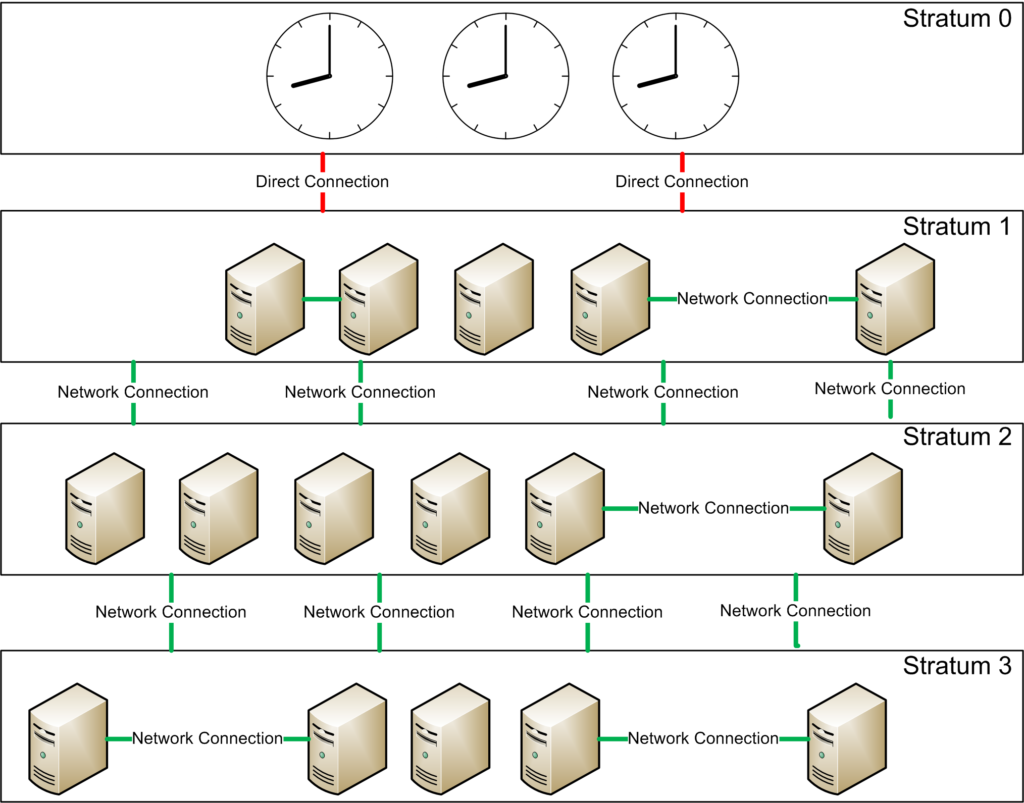
Image Credit : Linux Screen shots . License info
Comparison and Adoption
Compared to other time synchronization protocols like Precision Time Protocol (PTP) and Simple Network Time Protocol (SNTP), NTP stands out for its wide adoption, versatility, and robustness. While PTP offers nanosecond-level precision suitable for high-performance applications, NTP remains the go-to choice for general-purpose time synchronization due to its simplicity and compatibility.
Corporate Giants and NTP Servers
Large companies like Google, Microsoft, and Amazon operate their own NTP servers to ensure precise timekeeping across their global infrastructure. These servers, synchronized to authoritative time sources, serve as beacons of accuracy for millions of devices and services worldwide.
Time for Reflection: The Importance of NTP
Imagine a world without NTP – a world where digital transactions fail, communication breaks down, and critical systems falter due to desynchronized clocks. NTP’s absence would plunge us into chaos, highlighting its indispensable role in modern technology.
An interesting and real scenario where NTP is absent or not accurate which happens at higher strata clock – Imagine two machines, m1 and m2 are exchanging information. Their clocks are not in sync. m1 shows 10:05 am and m2 shows 10:00 am. Now m1 sends some data to m2. If I were to calculate the finite time it took to send this payload then it will be a negative number!
In conclusion, NTP stands as a testament to human ingenuity, enabling seamless synchronization across the digital realm. From its humble origins to its ubiquitous presence in our daily lives, NTP continues to shape the interconnected world we inhabit. So, the next time you glance at your device’s clock, remember the silent guardian working tirelessly behind the scenes – the Network Time Protocol.

References:
- Mills, D. L. (1991). Internet time synchronization: the network time protocol. IEEE Transactions on Communications, 39(10), 1482-1493.
- Nelson, R., & Mills, D. L. (2010). Chrony: A Different NTP Client. USENIX Annual Technical Conference (USENIX ATC), 175-186.